
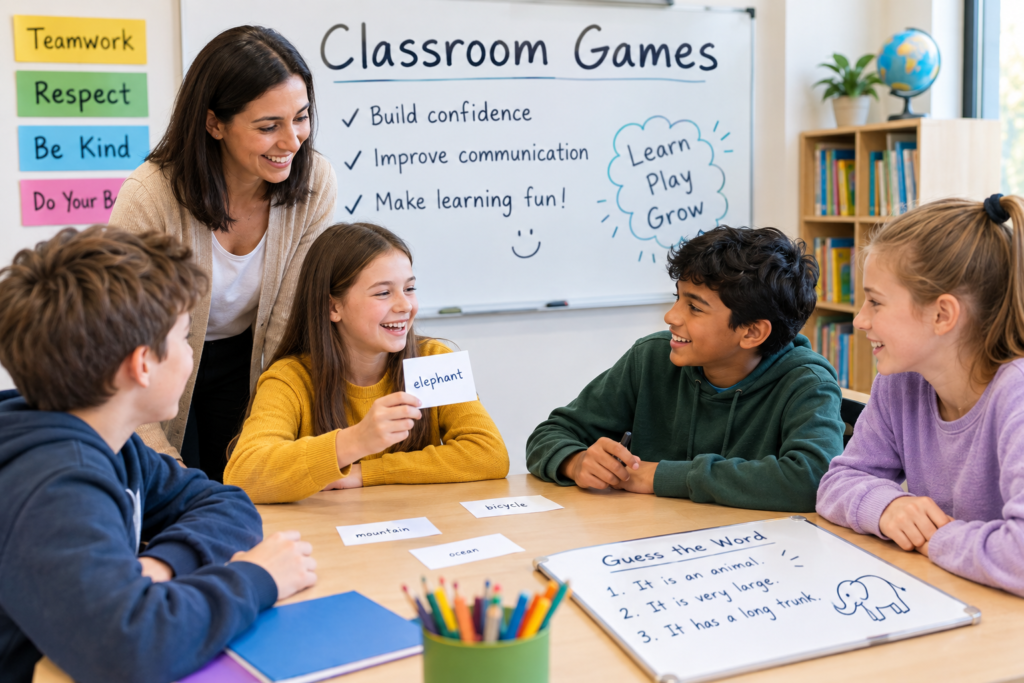
Keeping students interested throughout a lesson can sometimes be harder than explaining the lesson itself. After sitting and listening for a while, students can become distracted, tired, or simply lose interest. This is where classroom games can make a real difference.
A good classroom game gives students a chance to get involved instead of simply listening to the teacher. They can answer questions, work with classmates, move around, solve problems, use their creativity, and learn from mistakes.
The best part is that classroom games do not have to be complicated. You do not need expensive equipment or a classroom full of computers. A whiteboard, some paper, a few cards, or even just the students themselves can be enough to turn a normal lesson into something much more interactive.
What Are Classroom Games?
Classroom games are activities that teachers use to make learning more interactive and enjoyable. They can be used at almost any point during a lesson.
For example, a teacher might start the class with a quick guessing game to get everyone’s attention. During the lesson, students might play a team activity to practice a new skill. At the end, a short quiz game can be used to see what students remember.
Classroom games can be competitive, but they do not always have to be. Some are designed simply to encourage students to work together and communicate.
What matters most is that the activity has a purpose.
A game that helps students remember ten new vocabulary words, for example, can be much more useful than an activity that is simply entertaining.
Why Do Teachers Use Classroom Games?
Let’s be honest: not every student enjoys sitting quietly and taking notes for an entire lesson.
Games introduce some variety.
When students know that they are going to participate in an activity, they often become more curious about what is coming next. Even students who are normally quiet may become involved when the activity gives them a simple and comfortable way to participate.
Classroom games can help students:
- Remember new information
- Practice skills without feeling like they are doing another worksheet
- Improve communication
- Work as a team
- Develop problem-solving skills
- Build confidence
- Pay attention for longer periods
- Review previous lessons
- Become more comfortable making mistakes and trying again
Of course, games are not a replacement for teaching. They work best when they are used alongside explanations, practice, discussion, and other classroom activities.
Easy Classroom Games Teachers Can Try
You don’t need to spend hours preparing an activity. Some of the most useful classroom games can be explained in just a few minutes.
1. Guess the Word
This is a simple game that works especially well for English and vocabulary lessons.
Choose a word that students have recently learned. Give them clues one at a time and let them try to work out the answer.
For example:
Clue 1: I am an animal.
Clue 2: I am very large.
Clue 3: I have a long trunk.
The answer is elephant.
You can make the game easier or harder depending on the class.
For younger students, pictures can be used as clues. Older students can be asked to explain why they think their answer is correct.
2. Classroom Bingo
Bingo is one of those games that students usually understand immediately.
Instead of putting ordinary numbers on the cards, teachers can use words, pictures, answers, definitions, or mathematical problems.
For example, during an English lesson, the bingo card might contain vocabulary words. The teacher reads out definitions, and students mark the word that matches each definition.
It is a small change from traditional Bingo, but it turns the game into a useful revision activity.
3. Pictionary
Some students love drawing, and Pictionary gives them a chance to use that creativity during class.
Write a word on a small piece of paper and give it to one student. The student draws the word on the board while the rest of the class tries to guess it.
The person drawing cannot simply write the answer.
This can be used with everyday vocabulary, animals, places, science terms, actions, and many other topics.
And yes, the drawings do not have to be good. Sometimes the terrible drawings are what make the game funniest.
4. Charades
Charades is another classroom favourite because students have to communicate without using words.
One student acts out a word or phrase while the others try to guess it.
For an English class, you could use action words such as:
- Jumping
- Swimming
- Running
- Reading
- Dancing
- Sleeping
For older students, the words can become more challenging.
Charades can also work as a quick five-minute activity when students need a break from sitting at their desks.
5. The Board Race
If your class has lots of energy, a board race can be a good way to use it.
Divide students into teams and write a question on the board. One student from each team comes forward and tries to solve it.
For mathematics, the question could be:
36 × 4 = ?
For English, you could ask students to spell a word or complete a sentence.
The important thing is to keep the activity organised. Students should know when it is their turn and where they should stand while waiting.
6. Twenty Questions
One student secretly thinks of something. It could be an animal, object, place, person, or something connected to the lesson.
The other students can ask questions, but the answers can only be yes or no.
For example:
“Is it alive?”
“No.”
“Can we find it in a classroom?”
“Yes.”
“Is it made of paper?”
“Yes.”
The students continue asking questions until they figure out the answer.
This game is particularly useful because students have to think carefully about which question to ask next.
7. Hot Seat
Hot Seat is a fun choice for vocabulary practice.
One student sits at the front with their back to the board. The teacher writes a word behind them.
The rest of the class gives clues to help the student guess the word.
If the word is “apple,” students might say:
“It is a fruit.”
“It can be red or green.”
“You can eat it.”
The student has to figure out the answer without seeing the word.
8. True or False
This is one of the easiest classroom games to prepare.
The teacher reads a statement and students decide whether it is true or false.
For example:
“The Sun is a planet.”
Students answer:
False.
To make it more active, students can stand on one side of the room for “True” and the other side for “False.”
The teacher can then ask a student to explain the answer. This adds a learning element instead of turning the activity into simple guessing.
Classroom Games for English Lessons
English lessons are particularly easy to turn into games.
Teachers can use games for vocabulary, spelling, grammar, speaking, reading, and sentence-building.
Some simple ideas include:
- Word scramble
- Vocabulary Bingo
- Spelling race
- Missing word
- Story chain
- Pictionary
- Charades
- Guess the word
- Sentence-building race
- Word association
For example, in a story chain, one student starts a story with one sentence. The next student adds another sentence, and the story continues around the classroom.
The results can become surprisingly funny while students are practising their English at the same time.
Classroom Games for Math
Math practice does not always have to mean completing page after page of questions.
Games can give students another way to practise calculations.
Try activities such as:
- Number Bingo
- Mental math challenges
- Times-table races
- Equation puzzles
- Shape hunts
- Number guessing
- Math quizzes
- Problem-solving challenges
A teacher could write several equations on the board and have teams solve them as quickly as possible.
However, speed should not be everything. It is also important to give students time to explain how they reached their answer.
Classroom Games for Science
Science can also become much more interactive through games.
For example, students could play a classification game where they decide whether an item belongs to a particular group.
Teachers can also use:
- Science quizzes
- Mystery object games
- Label-the-diagram activities
- Animal guessing games
- Science Bingo
- True or False
- Science vocabulary games
A mystery object activity can be particularly interesting. The teacher gives clues about an object, and students have to identify it.
Classroom Games Without Technology
One of the biggest advantages of classroom games is that many of them do not require technology.
You can have a great activity using nothing more than:
- A whiteboard
- Paper
- Pens
- Flashcards
- Sticky notes
- A few printed cards
Games such as Charades, Pictionary, Twenty Questions, Board Race, and Word Guessing can all be played without phones or computers.
This is useful for teachers who want to make lessons more interactive without adding more screen time.
Classroom Games for Different Age Groups
Not every game works for every age group.
Younger Students
Younger children often enjoy activities involving movement, pictures, sounds, and simple rules.
Good choices include:
- Picture Bingo
- Simon Says
- Charades
- Matching games
- Drawing games
- Simple quizzes
Older Students
Older students can usually handle games with more complicated rules and problem-solving.
Try:
- Team quizzes
- Debate-style activities
- Word challenges
- Mystery games
- Puzzle competitions
- Subject-based trivia
The key is to make the activity challenging without making it frustrating.
How to Make Classroom Games Work Better
A classroom game can look fantastic on paper and still become chaotic when thirty students start playing it.
A little preparation can make a big difference.
Explain Before You Start
Do not begin the game until everyone understands the rules.
A quick example is often better than a long explanation.
Keep It Simple
If students spend more time trying to understand the rules than actually playing, the game probably needs to be simplified.
Give Everyone a Role
Try not to let the same few students answer every question. Give different students opportunities to participate.
Don’t Make Winning Everything
Competition can be fun, but students should not feel embarrassed if they lose.
The main purpose is still learning.
Keep an Eye on Time
A classroom game does not need to take thirty minutes. Sometimes a five-minute activity is all you need to refresh the class.
What Makes a Good Classroom Game?
A good classroom game should be enjoyable, but fun is only part of the picture.
A useful game should also:
Have a clear purpose. Students should practise something connected to the lesson.
Be easy to understand. Students should know what they are supposed to do.
Include as many students as possible. Avoid activities where only one or two students participate.
Match the students’ level. Too easy becomes boring, while too difficult can become frustrating.
Fit the available time. Choose something that works with the time you actually have.
Frequently Asked Questions
Are classroom games useful for learning?
Yes. Classroom games can give students additional opportunities to practise concepts, recall information, communicate, and solve problems. Their effectiveness depends on how well the activity matches the learning objective.
Can I use classroom games every day?
You can use short games regularly, but there is no need to turn every lesson into a competition. Games work best as one part of a varied teaching approach.
What are the easiest classroom games to prepare?
Some of the easiest options include Twenty Questions, True or False, Charades, Pictionary, Word Guessing, and Board Races.
Do classroom games have to be competitive?
No. Games can focus on teamwork, creativity, communication, or problem-solving instead of having winners and losers.
Can classroom games be used for online learning?
Yes. Some games can be adapted for online classes using digital quizzes, virtual whiteboards, chat activities, and interactive presentations.
Conclusion
Classroom games can turn a routine lesson into something students remember. They give learners a chance to participate, talk to one another, solve problems, and practise what they have learned in a less formal setting.
The trick is not to find the most complicated game. Often, a simple five-minute activity can be enough.
Start with the lesson objective, think about what students need to practise, and then choose a game that supports that goal. When the activity is enjoyable and useful, students are more likely to stay involved and remember what they learned.
Whether you are teaching English, mathematics, science, or general knowledge, there is almost always a classroom game that can fit the lesson.